

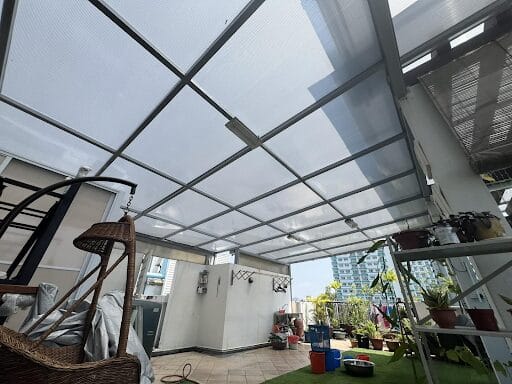
You want your patio bright and open. You also want it cool and dry. Feels like you can’t have both, right?
That’s the exact problem polycarbonate was built to solve. It lets the daylight in but keeps the burn and the downpour out. Well, mostly. The details matter, and this is where a lot of homeowners get it wrong.
So let’s clear it up. Here’s how a polycarbonate awning in Singapore actually handles our afternoon heat and our monsoon rain, and how to pick the right sheet so you’re not stuck under a hot, noisy roof.
How Polycarbonate Beats the Afternoon Heat
Here’s the thing about our sun. It’s not just bright. It carries UV that fades your furniture, ages your skin, and slowly wrecks cheaper materials.
Good polycarbonate has a UV-protective layer that blocks almost all of it, around 99%. That coating shields you and your patio, and it stops the sheet itself from going brittle or yellow too fast. But blocking UV is only half the job. The other half is heat.
Clear polycarbonate lets light and solar heat pass through, so on a west-facing patio at 3 pm, it can still feel warm underneath. This is the part sellers gloss over. The fix is in the sheet you choose, and in going with a twin-wall sheet that traps air to slow the heat down.
Clear vs Tinted vs Opal: Which Sheet Keeps You Cool?
Not all polycarbonate is the same. The color and build of the sheet decide how much light you get and how much heat you block. Here’s the honest breakdown.
| Sheet Type | Light Let In | Heat Control | Best For |
|---|---|---|---|
| Clear | Most, with a view up | Lowest | Bright spaces, shaded or east-facing sides |
| Tinted (bronze or grey) | Medium, softer glare | Medium | Balancing light and heat, most patios |
| Opal (white) | Soft and diffused, no view | Highest | Hot, west-facing patios |
Want the brightest space? Clear wins, but you’ll feel more heat. Want the coolest? Opal blocks the most sun and glare, though you lose the clear view up. Tinted sits in the middle, cutting glare and some heat while keeping decent light. Twin-wall versions of any of these insulate better than solid sheets, so the space stays cooler.
There’s no single right answer. It depends on which way your patio faces and how much light you’re chasing.
How It Holds Up When the Monsoon Hits
Now the rain. And in Singapore, when it rains, it pours.
Polycarbonate is fully waterproof, so it sheds heavy rain no problem. But here’s what matters: the slope. A polycarbonate awning needs the right pitch, so water runs off fast instead of pooling. Get the angle wrong and you’ll hear water sitting up there and see it drip at the edges. Get it right and it drains clean, every time.
What about a real storm, with wind? This is where polycarbonate quietly shines. It’s tough and slightly flexible, so it takes a gust, and even a falling branch, far better than glass, which can crack. On a proper aluminium frame with the right fixings, it stays put through the worst of a Sumatra squall.
One honest heads-up. Rain can be loud on a solid polycarbonate sheet. If a noisy roof would bug you, a twin-wall sheet dampens the sound a lot. Worth knowing before you commit.
Polycarbonate vs Fabric vs Metal: The Heat Test
So how does it stack up against the other popular covers for keeping cool? Each one handles heat in its own way.
| Cover | Heat Handling | Daylight | Best When |
|---|---|---|---|
| Polycarbonate | Good, better when tinted or opal | Yes, filtered | You want light, shade, and rain cover in one |
| Fabric (retractable) | Very good, breathable | Some, soft | You want an open, adjustable feel |
| Metal (aluminium) | Best, full block | None | You want the coolest, darkest, most permanent cover |
Fabric, like a retractable fabric awning, breathes and blocks direct sun, so the space feels airy and cool. But it doesn’t give you a fixed, all-weather roof. Metal, like an aluminium composite panel, blocks the sun completely and stays coolest and darkest, though you lose all the daylight.
Polycarbonate is the in-between. It’s the only one that gives you daylight, UV protection, heat control, and solid rain cover in a single fixed sheet. That’s why it’s such a favorite for patios and driveways. Want the full side-by-side? See our guide that compares all four awning materials, or our fixed versus retractable comparison if you’re still deciding between a permanent cover and a fold-away one. That’s the call The Secret of Awning helps homeowners make every week.
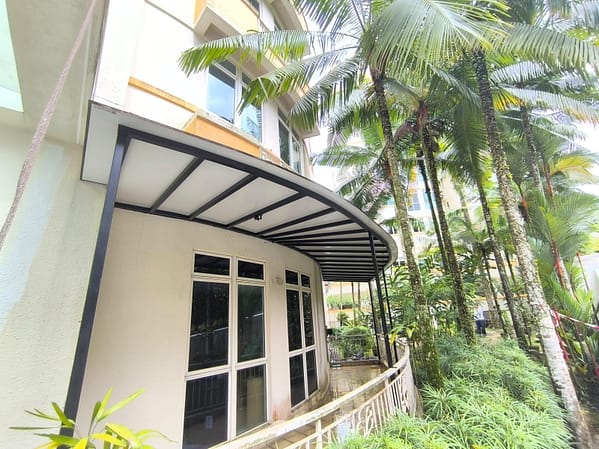
Made for Singapore, Not a Mild Climate
Look, a polycarbonate awning that works in a cool country can fail here. Our conditions are harsher: relentless afternoon sun, sky-high humidity, and monsoon rain that comes in sideways.
That’s where experience counts. At The Secret of Awning, we’ve fitted polycarbonate across Singapore since 2013. We know which grade holds its color, which slope drains our rain, and which sheet suits a west-facing patio versus a shaded side yard. We don’t guess. We match the sheet to your space.
Cheap, thin polycarbonate yellows and cracks within a few years under our sun. The right grade, fitted properly, lasts 10 to 15 years. That gap is the whole ballgame, and it’s why honest material advice beats a low quote every time.
Frequently Asked Questions
Can a polycarbonate awning cut the heat on my patio in Singapore?
Yes, but the sheet you choose decides how much. All quality polycarbonate blocks around 99% of UV, which stops fading and takes the harsh edge off the sun. For actual heat under the cover, tinted or opal sheets work best because they reflect and absorb more solar heat than clear ones. A twin-wall sheet adds insulating air pockets that keep the space cooler still. On a hot west-facing patio, we usually steer homeowners toward tinted or opal twin-wall rather than clear.
Can a polycarbonate patio awning handle heavy tropical rain?
Yes. Polycarbonate is fully waterproof and sheds heavy rain easily, as long as it’s installed with the right slope so water runs off instead of pooling. It’s also impact-resistant and slightly flexible, so it handles strong monsoon wind and falling debris better than glass. The one trade-off is noise: rain can be loud on a solid sheet, though a twin-wall sheet muffles it well.
Does polycarbonate get noisy when it rains?
It can, especially a single solid sheet during a downpour. If quiet matters to you, a twin-wall or multiwall sheet reduces the drumming noticeably because the air layers absorb sound. Correct fixing and slope help too, by letting water flow off smoothly instead of pounding one spot.
How long does a polycarbonate awning last in Singapore?
A good-grade polycarbonate awning lasts around 10 to 15 years here. The UV coating is what protects that lifespan, so sheet grade matters a lot. Cheap sheets without proper UV protection can yellow or turn brittle within a few years under our strong sun, which is why we only fit sheets built for tropical conditions.
The Bottom Line on Polycarbonate
Let’s wrap it up. A polycarbonate awning gives you something rare: daylight and shade, heat control and rain cover, all in one fixed sheet.
The secret is in the details. Pick clear for brightness, tinted for balance, or opal for the coolest patio. Choose twin-wall to cut heat and noise. And get the slope and fixings right so it drains our monsoon rain and rides out the wind.
Do that, and you get a patio you can use at 3 pm and during a downpour. The Secret of Awning has dialed in those details on Singapore homes since 2013, and we’re glad to help you get it right too. Explore our polycarbonate awning options, or book a free on-site visit and we’ll show you which sheet fits your space.